This is the Bluetti Elite 300 — a 3 kWh power station that gives you more capacity without needing expansion batteries. It’s still relatively portable, offers fast charging and excellent efficiency — but there are some important trade-offs you need to know about.
In this article I’ll show you what it does well, where it falls short, and how it compares to other power stations like the EcoFlow Delta 3 Max Plus and DJI Power 2000 — based on detailed real-world testing and measurements.
So let’s take a closer look.
Overview

The power station only comes with a mains charging cable, manual and a grounding screw – there’s no car or solar charging cable included.
This is the first power station I’ve tested with a built-in battery over 2 kWh. The Elite 300 has a 3 kWh (3,014 Wh) LFP battery rated for 6000 charge cycles.
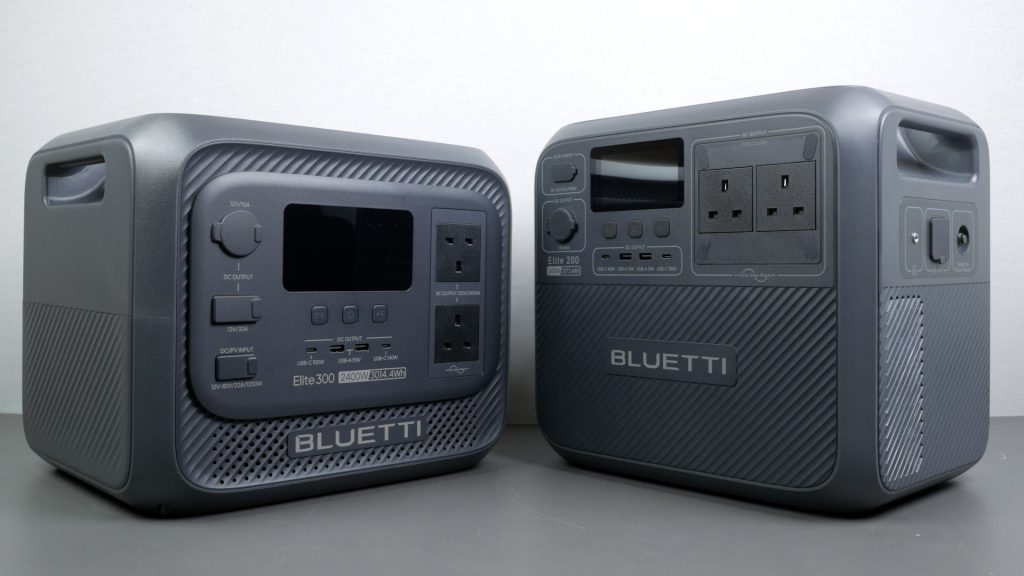
It weighs 26.3 kg — only about 2 kg heavier than the Elite 200 V2 — and it’s not dramatically larger either, so still manageable to move around.
Build quality is good – the exterior is mostly hard plastic. There’s no official weatherproof rating though, so you do need to be careful about using it outdoors.
Around the front you’ve got the display, USB ports including a 140 W USB-C, two 12 V outputs, DC input and two AC outlets. Around the side is the AC input and circuit protection.
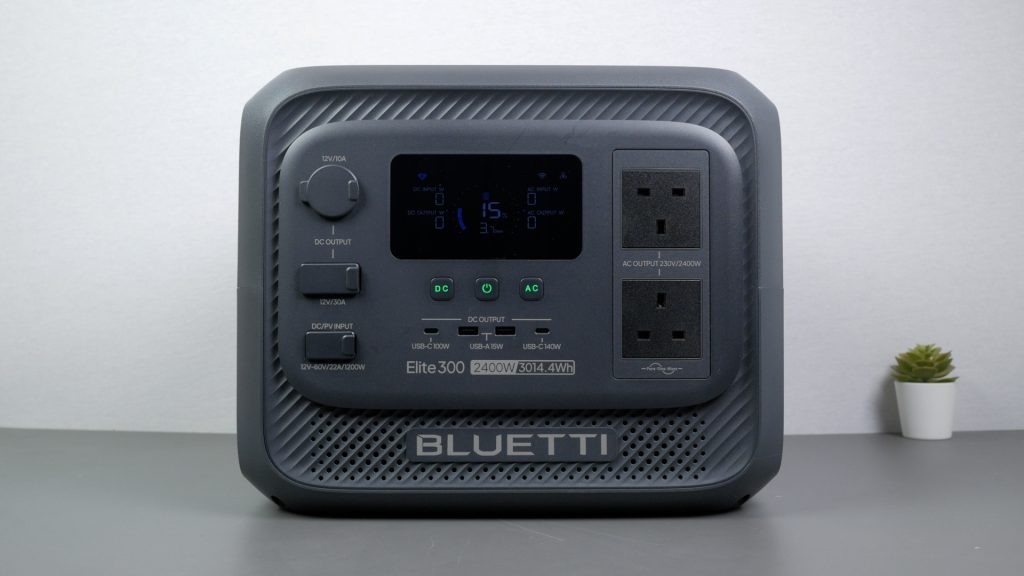
A long press of the main power button turns the unit on, another single press toggles the display, and a long press turns it off. Either side of that are the buttons to toggle the DC including the USB ports and the AC outlets.
Charging
The power station can charge from mains power, solar panels, or your car.
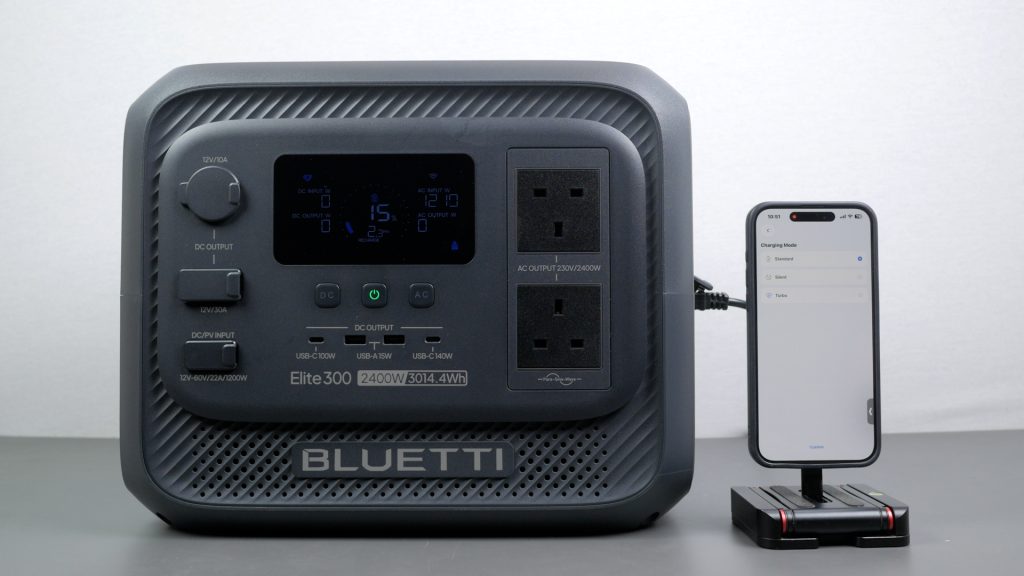
Main charging speeds will vary depending on location, but here in the UK if you enable Turbo charging in the app, the Elite 300 charges at 2300 W. I charged the unit from completely flat to 80% in 1 hour 12 minutes – a fair bit faster than Bluetti’s “under 1.5 hour” claim.
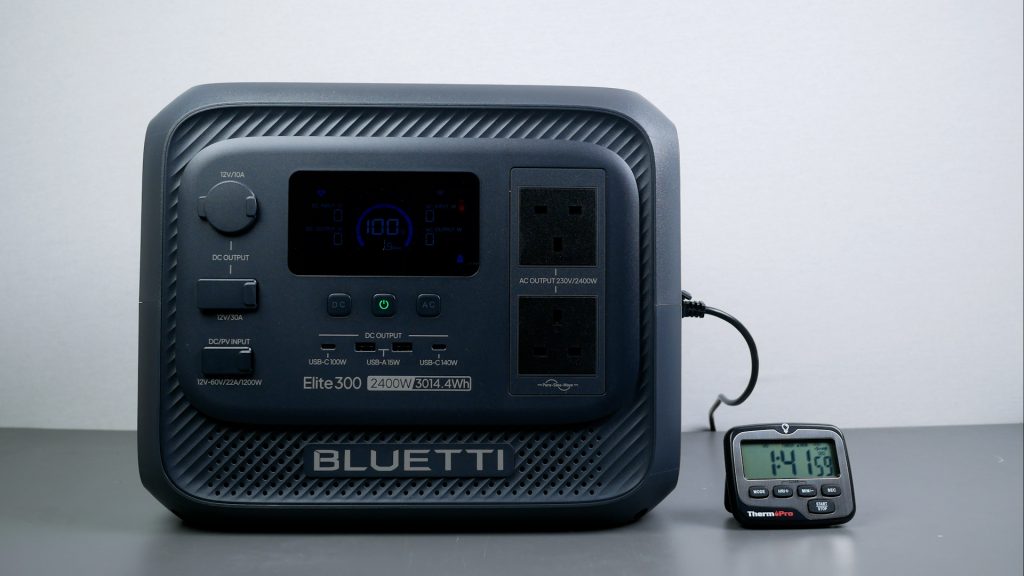
A full charge took 1 hour 42 minutes, although this will vary depending on temperature and battery conditions.

It’s not the quietest power station I’ve tested – I measured around 50 dB 1 metre from the power station.
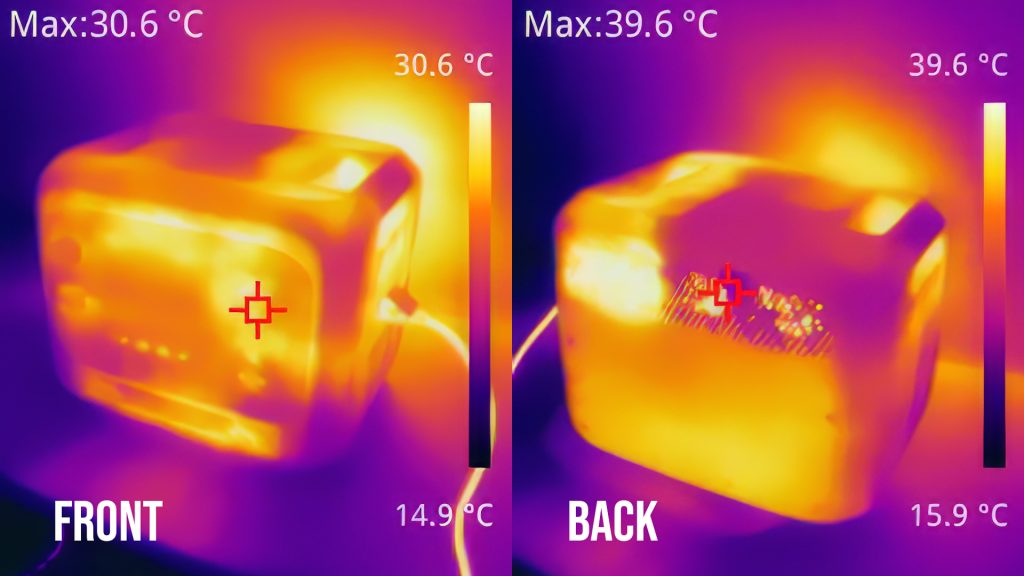
The fans do keep the unit quite cool though as you can see with my thermal camera images. But compare that to the EcoFlow Delta 3 Max Plus I just reviewed where I could barely hear the fans – also charging the unit at full speed.
You can drop the charging speed: Standard mode charges at 1200 W and Silent mode at 800W. The fans are quieter in Silent mode but when they come you can definitely still hear them.
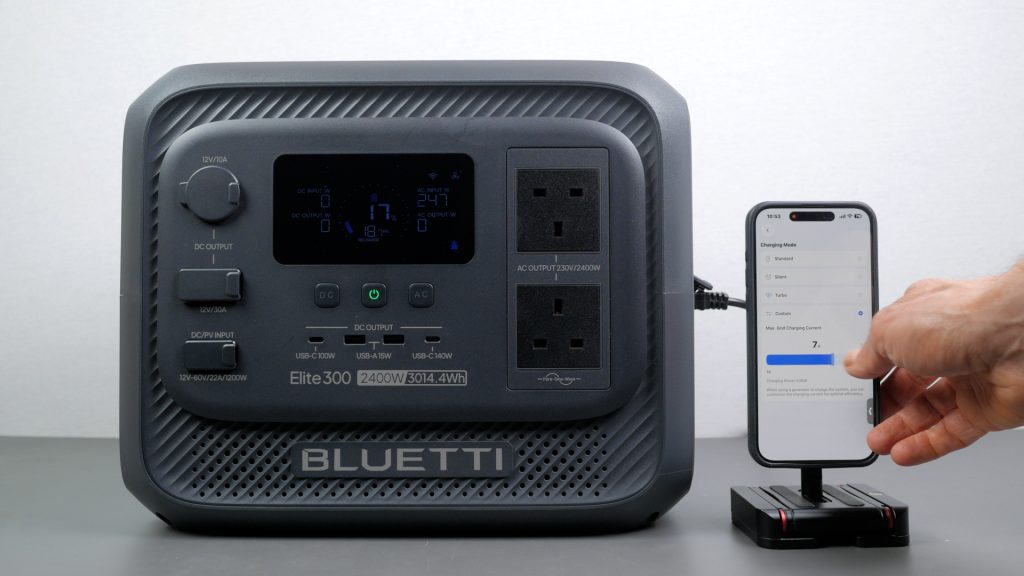
You can also set a custom charging speed from 1 A to 10 A. This should really be in Watts – Amps will be confusing to the average user. Disappointingly even charging at 1 A – just 250 W, I still had the fans turn on intermittently.

With the optional car charging cable, you can charge from your car’s 12 V outlet at around 105 W — so a full charge would take well over a day.

Some vehicles have a 24 V system that will double that speed, but it’s not that common.

I initially got slightly strange results using my van’s 12 V car outlet – but realised you have to go into the Advanced Settings in the app and set the DC Input Source to Others for charging off your car’s battery. By default it’s set to PV for solar charging.
Putting this back to PV mode I tested this same DC input for solar charging. The Elite 300 can charge at up to 1200 W via its integrated MPPT controller. There’s only one XT60 input so it’s not as flexible as say the EcoFlow Delta 3 Max Plus, but with the right panels and enough sun you might achieve 1200 W.
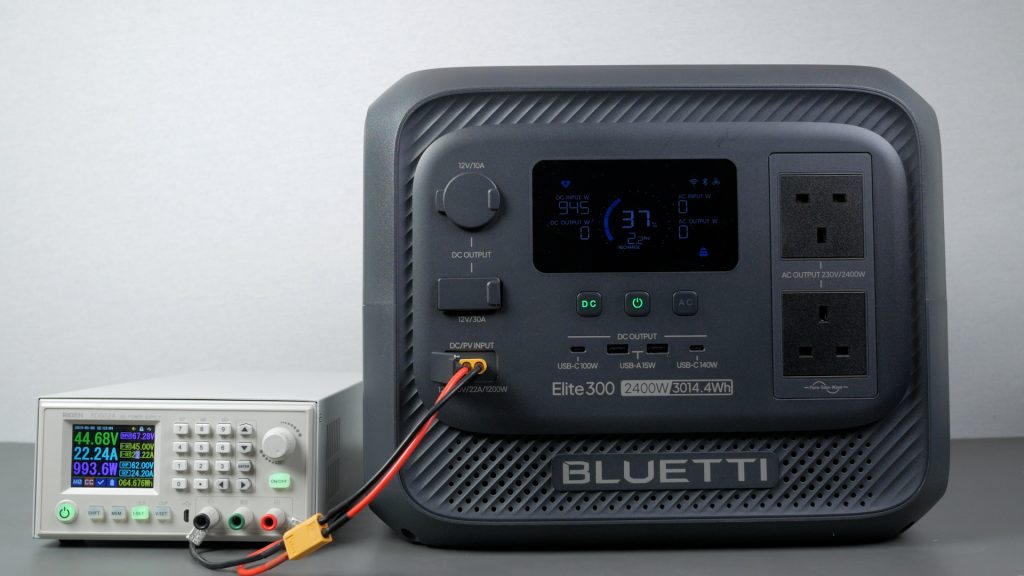
The solar input is 12-60 V at up to 22 A. My bench power supply only has 1000 W maximum output so I could only set the voltage up to 45 V but I at least confirmed the maximum current.

When the sun made an appearance I tested the Elite 300 initially with a single Bluetti PV350 350 W foldable panel. You’ll need a MC4 to XT60 adapter which isn’t supplied with the power station or panel. I got around 250 W which is pretty good. With the 60 V maximum input you’ll have to connect your typical panels in parallel – series would overload the input.
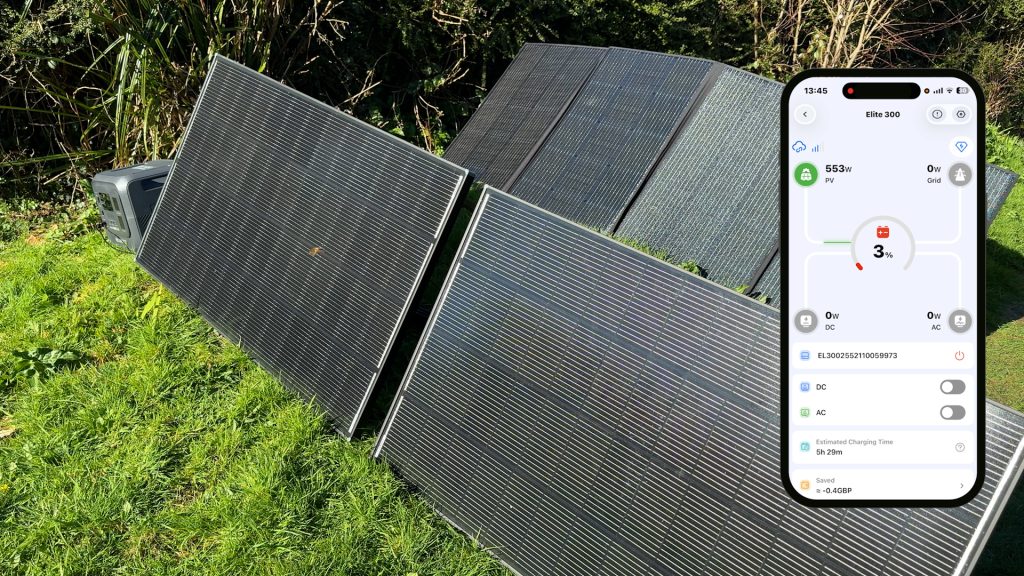
I added two Renogy 200 W panels, using these parallel adapters which makes it super easy. With all panels connected up I got around 550 W at around 31 V so just under 18 A. Ideally you’d want some higher voltage panels for the best results with this setup, otherwise you’ll just hit the current limit well before the 1200 W limit.
Performance
The Elite 300 has two 2400 W pure sine wave AC outlets. That’s considerably lower than most other 2 kWh power stations I’ve tested. Even the Elite 200 V2 can output 2600 W, and units like the EcoFlow Delta 3 Max Plus and DJI Power 2000 offer 3000 W and four AC outlets.

There is Power Lifting Mode that lets you run purely resistive loads like heaters and hair dryers up to 3900 W — but I’d leave this off in most cases, as it works by lowering the output voltage, which isn’t suitable for sensitive electronics.

I tested the output to its limit with a steady load charging another power station and then ramping up an electric heater until I overloaded the power station. It could run beyond its 2400 W at least for a short while and only switched off at over 2800 W. I also ran it at its maximum 2400 W load for over 10 minutes without any issues.

I tried various real world tests around the house and in the garage.

Around the house it could run a vacuum cleaner, coffee machine and it would excel at running your fridge and freezer in a power outage. My full height fridge and freezer combined use around 844 Wh per day – so you could run them for over three days off this power station!

In the garage it could run most corded power tools including my beefy Dewalt circular saw.

Checking this with my clamp meter, that pulls over 20 A or over 4600 W at startup confirming Bluetti’s claim it can handle surges of up to 4800 W.

It also easily coped with my 100 L compressor, and my Festool tracksaw and vacuum combined.

However, it couldn’t run any of my machinery. I can normally get these larger power stations to at least run my bandsaw, but with a startup draw of over 26 A which is over 6000 W it was too much for the Bluetti.

AC inverters can consume a surprising amount of power even with no load attached. In Eco mode, the AC subsystem will turn off if there’s no load attached, but with Eco mode turned off I left the unit overnight for 16 hours with no load connected.

After 16 hours the battery dropped from 100% to 90% so just having AC turned on uses around 19 W per hour. This is the best result I’ve seen from a larger power station – which will be partly due to the slightly smaller inverter.

To measure usable capacity, I used an energy monitoring plug and ran a constant 1 kW resistive load using an electric heater. The power station ran for 2 hours 46 minutes and delivered 2819 Wh from its 3014 Wh battery. That’s an impressive 94% efficiency, which is excellent for a unit of this size.
One thing to note is the Elite range isn’t expandable — so you can’t add extra battery capacity.
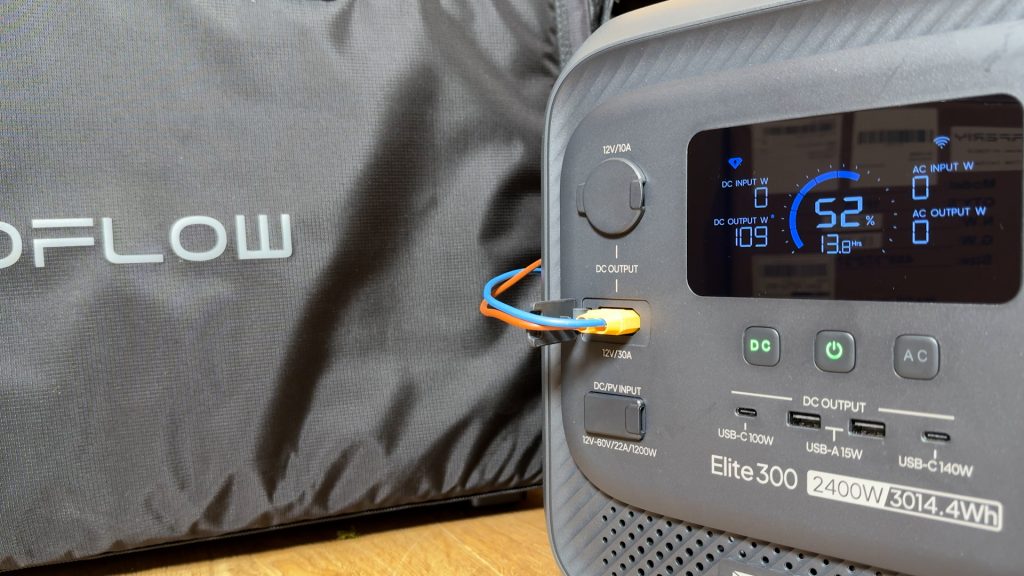
It’s great to see Bluetti include a 12 V 30 A DC output via XT90. This 30 A output is useful for higher demand devices like fridges and diesel heaters that can spike well above the typical 10 A limit. It also allows you to run multiple DC loads at the same time, for example in a campervan.

There’s also a standard 12 V 10 A car socket for more typical accessories. I tested both DC outputs to their limits using a load tester. The 10 A output got to 14.5 A and the 30 A output reached 31.1 A before overloading the power station. Although the voltage did drop at the higher outputs on the 10 A output it still reached over 180 W which you don’t often see on a standard 12 V car outlet.
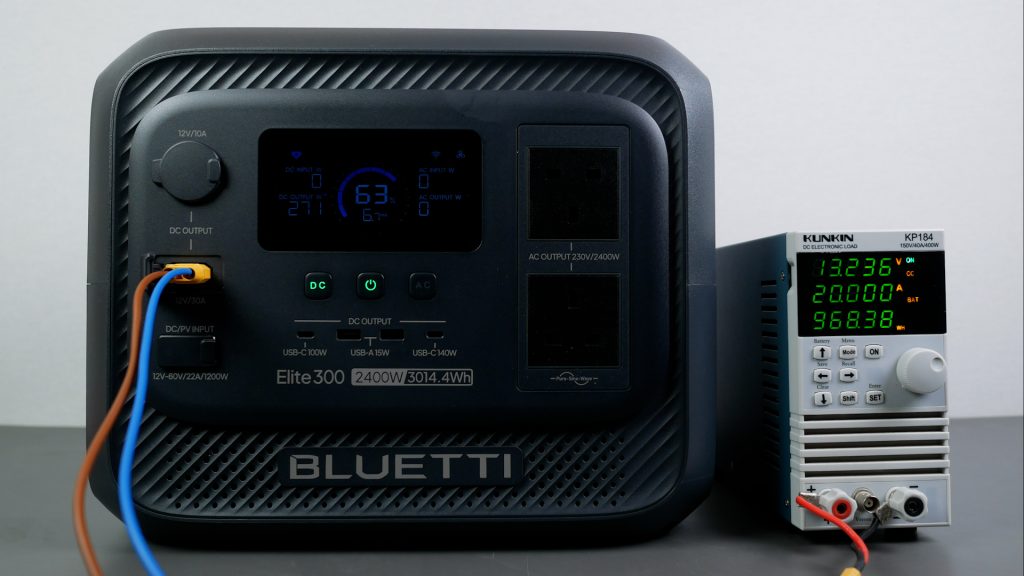
I measured DC efficiency using the XT90 output with a 20 A load. The usable energy came out at 2866.2 Wh, which is a super impressive 95% efficiency. I also measured DC idle drain with DC enabled, no load attached, and DC Eco mode turned off.

Over 16 hours the battery dropped from 100% to just 98%, which works out at less than 4 W of idle draw – one of the best results I’ve seen. So both AC and DC efficiency are excellent, as is idle consumption.

You need to enable DC to use the USB outputs, and the Elite 300 offers a decent selection: one 140 W USB-C port, one 100 W USB-C port, and two 15 W USB-A ports.
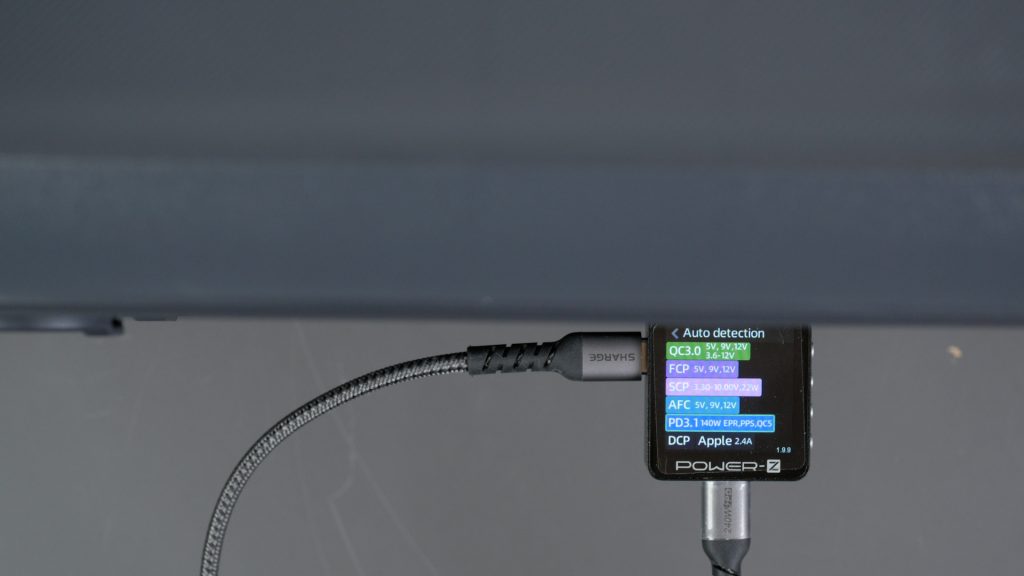
I tested all ports at full speed and checked their supported charging standards. The USB-A ports don’t support fast charging — just standard 5 V output.

I also tested charging very low power items like my AirPods Pro which only draw around 1W. Even off the 140 W USB-C port they kept charging for more than 30 minutes so it doesn’t prematurely cut off very low-power devices, at least with Eco mode turned off.

I loaded all the USB ports while also running a 2 kW heater from the AC outlet with no issues. All ports support passthrough charging, so you can charge the power station and power devices at the same time.

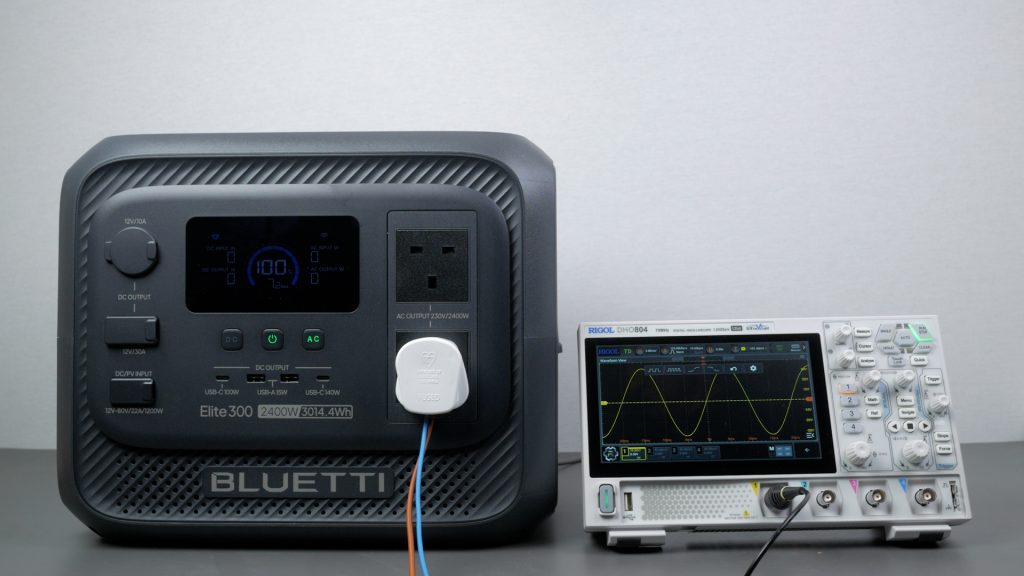
Like most power stations, the Bluetti includes a UPS, or uninterruptible power supply mode. When the unit is plugged into mains power, connected devices run directly off mains rather than the battery. In the event of a power cut, the switch‑over to battery happens almost instantly – in less than 10 ms according to Bluetti.
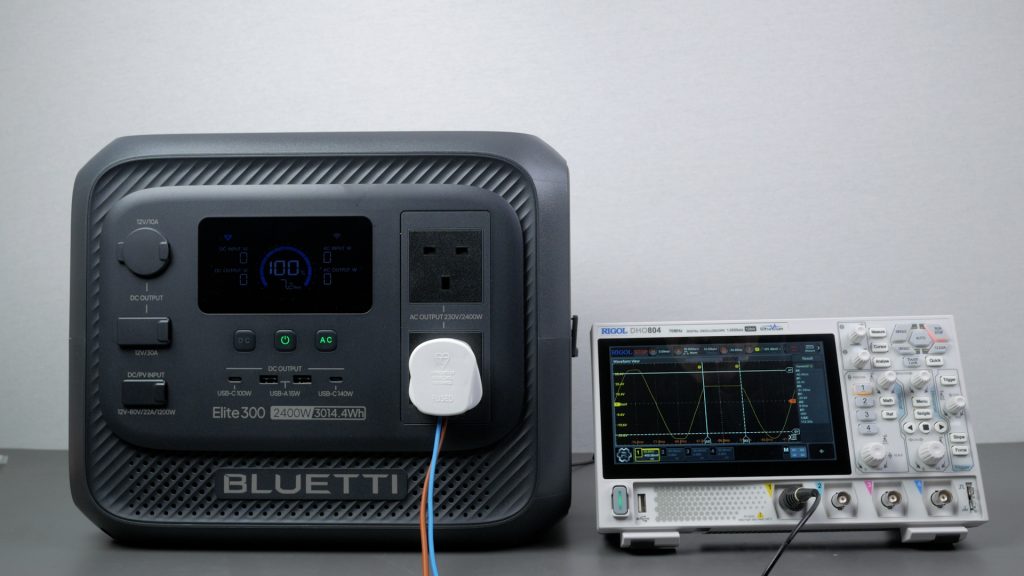
I confirmed their claims with my oscilloscope, measuring the transfer time at just 8.9 ms and tested this in real-world use with my desktop PC running an intensive graphics benchmark – it handled the transition flawlessly.

Bluetti’s smartphone app connects over Bluetooth or WiFi. It’s capable, but a bit overcomplicated. As I mentioned earlier, DC charging is buried in the settings, and Working Modes — such as scheduling charging for off-peak electricity — aren’t explained in the app, so most people will likely miss them.
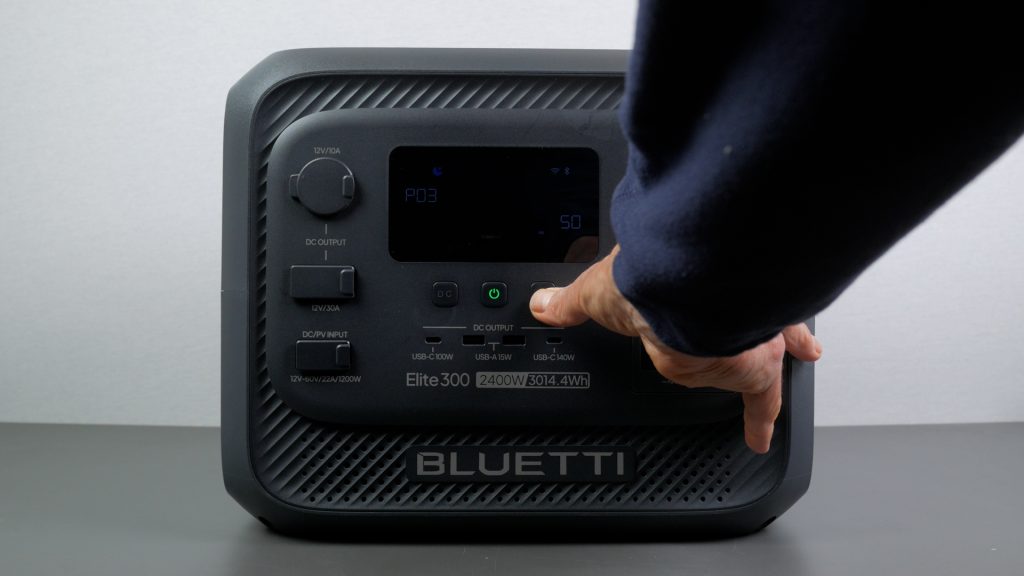
They are covered in the manual, but that’s not ideal. It is handy that a lot of the settings on the Elite 300 can be configured using buttons on the unit – without needing to use the app.
Conclusions
The Bluetti Elite 300 is a very interesting power station. That larger 3 kWh capacity in a still relatively portable unit will appeal to a lot of people, and it delivers excellent efficiency — both in usable output and idle consumption.
Bluetti positions it for camping and campervan use, and the extra capacity along with the 30 A DC output make it well suited for that. But it also works very well as a home backup solution.
The inverter is a little underpowered compared to some rivals, but for most people the bigger drawback will be the fan noise. Silent mode helps, but it’s definitely not silent — and I wouldn’t really want it running nearby while sleeping. Hopefully this is something Bluetti can improve with a firmware update, and I’ll update this article if that happens.

Price is always tricky with power stations given the frequent discounts, but even with current deals this isn’t cheap. It’s around £500 more than the Elite 200 V2, so you have to decide whether that extra 1 kWh is worth it. You do gain a 140 W USB-C port, but the 200 V2 has a slightly more powerful inverter. The DJI Power 2000 is currently even cheaper, offers four 3000 W AC outlets, and is one of the most expandable 2 kWh units I’ve tested.
Overall though, the Elite 300 is a strong option if you want more capacity in a still portable unit — without needing expansion batteries.
Don’t forget to take a look at my YouTube video at the top of the page, and again please subscribe to my YouTube channel where I’m releasing videos every week on the latest technology and how to get the most out of it. If you tap the bell icon when you subscribe you’ll get a notification as soon as I release a video, and there’ll be a link to my site here for the written article. YouTube is also the best place to leave a comment. I read all of them and respond to as many as I can!
Amazon links:
Bluetti Elite 300: https://amzn.to/4uQucQR
Leave a Reply