The EcoFlow Delta 3 Max Plus is one of the most capable “do-it-all” higher capacity portable power stations I’ve tested to date. It has four full-power 3000-watt AC outlets, flexible 1000-watt solar input, a 2048-watt-hour LFP battery with excellent real-world efficiency, proper desktop-grade UPS functionality, and one of the most complete smartphone apps I’ve used on a power station.
I’ve been testing it extensively around the house, in my workshop, and in my office, performing a wide range of real-world tests — including charging options and speeds, AC and DC efficiency, idle consumption, USB performance, UPS behaviour, expansion battery support, and how it behaves with demanding loads. In this video I’ll show you what it does well, where its limits are, and how it performs compared to other large power stations like the DJI Power 2000.
So let’s take a closer look.
Overview

The power station comes with just the mains charging cable and a quick start guide.

The first thing I noticed getting it out of the box is its weight. At 22.1 kg (48.7 lbs) it’s one of the lighter 2 kWh power stations I’ve tested. You’ll mostly need two hands, but I can carry this with one hand for shorter distances. It’s a little larger in volume than other comparable power stations – you can see how it compares to the DJI Power 2000 I reviewed recently and the Bluetti Elite 200 V2 I’ll be reviewing soon.
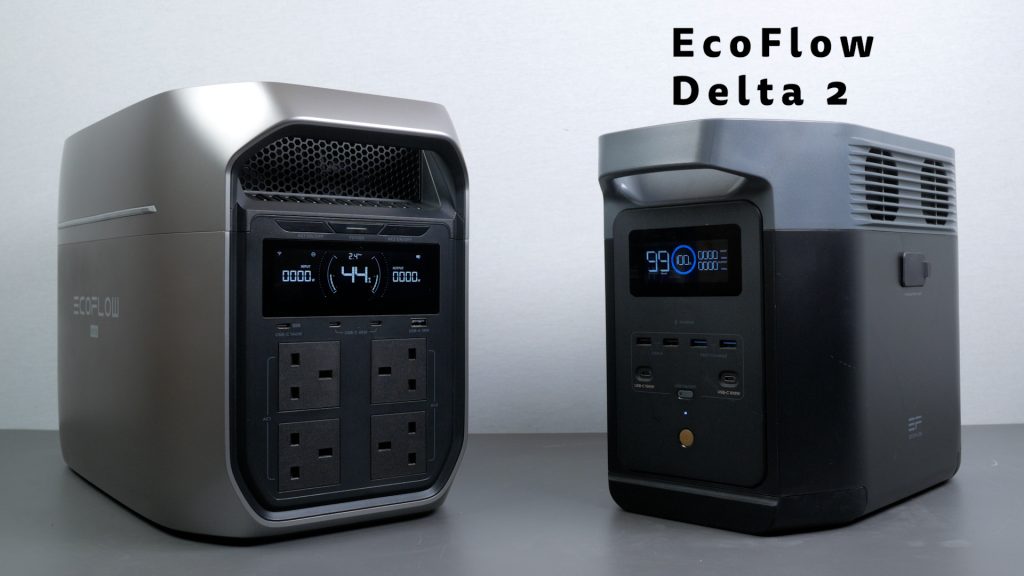
Like all the big power station brands, it feels very well made and it keeps the overall design of its predecessors, the Delta 2 and Delta 2 Max. Like nearly every power station I’ve tested, it has no weather-proof rating.
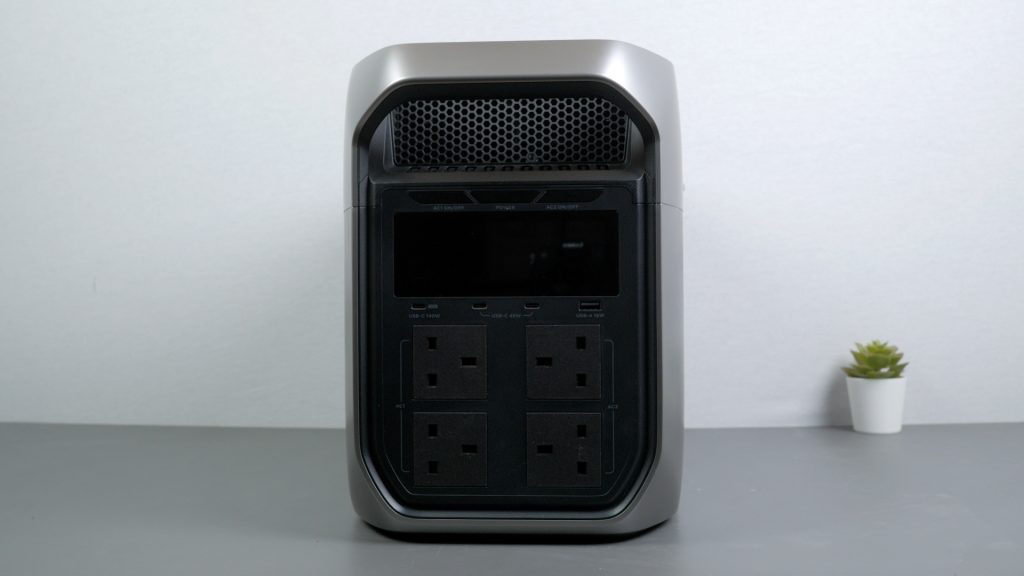
Around the front there’s the large display, four USB ports including one 140 W USB‑C port, and four 3000 W AC outlets. I’m glad EcoFlow has finally moved the AC outlets to the front. This makes much more sense, especially if you have the power station tucked into a corner.

Around the back of the unit, behind two covers that neatly slide out of the way, there’s the mains charging input with its fast‑charging switch and the two XT60 DC inputs. Below that is the expansion battery port and the two DC outputs, together with their power button.

A single press of the main power button turns the unit on, another single press toggles the display, and a long press turns it off. Either side of that are the buttons to toggle the AC outlets, which are split into two independent groups.
Charging
The power station can charge from mains power, solar panels, or your car.
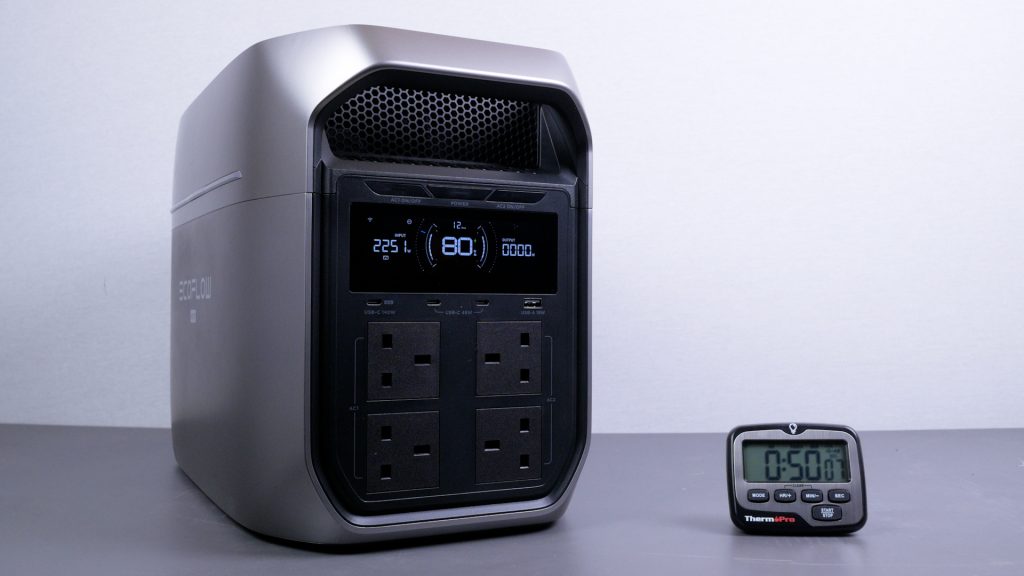
Charging via mains is the most straightforward and, like most modern power stations, very fast using the included standard cable. With the charging switch set to Fast, the unit charges at up to 2300 W. EcoFlow claims 47 minutes to reach 80% and 68 minutes for a full charge. In my tests it got very close, reaching 80% in 50 minutes and 100% in around 70 minutes, peaking at just under 2300 W.

What impressed me most wasn’t just the speed, but how quiet it was. Even charging at full power I had to be right next to the unit to hear the fans. My decibel meter barely registered above room noise at one metre.

The unit also stayed fairly cool: my thermal camera measured just over 40 °C at the exhaust fan. These results will vary depending on ambient temperature – my office was around 19 °C. Overall taking into account speed and noise, this is one of the best mains‑charging performances I’ve seen.
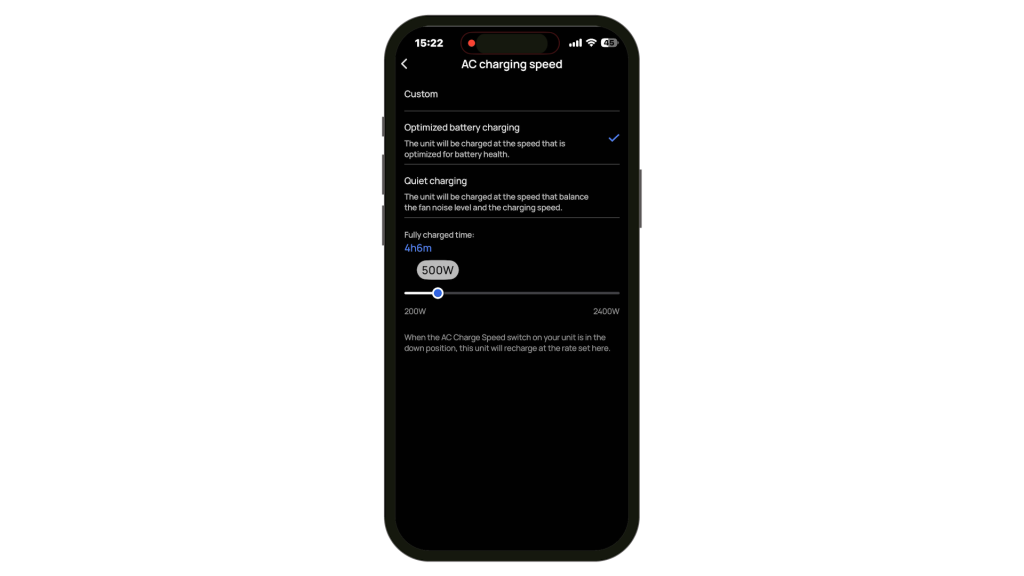
If you switch charging to Adjust, you can set a custom charging speed in the smartphone app all the way down to 200 W. EcoFlow also includes two quick‑select options: a 500 W Optimised mode and a 200 W Quiet mode if any fan noise bothers you. You can also monitor the internal temperature in the app, and if the unit is too warm you may not get the maximum charging speed until it cools down. After running the unit down with heavy use, I didn’t see charging go above about 1200 W until it cooled, and a full charge took just over two hours.
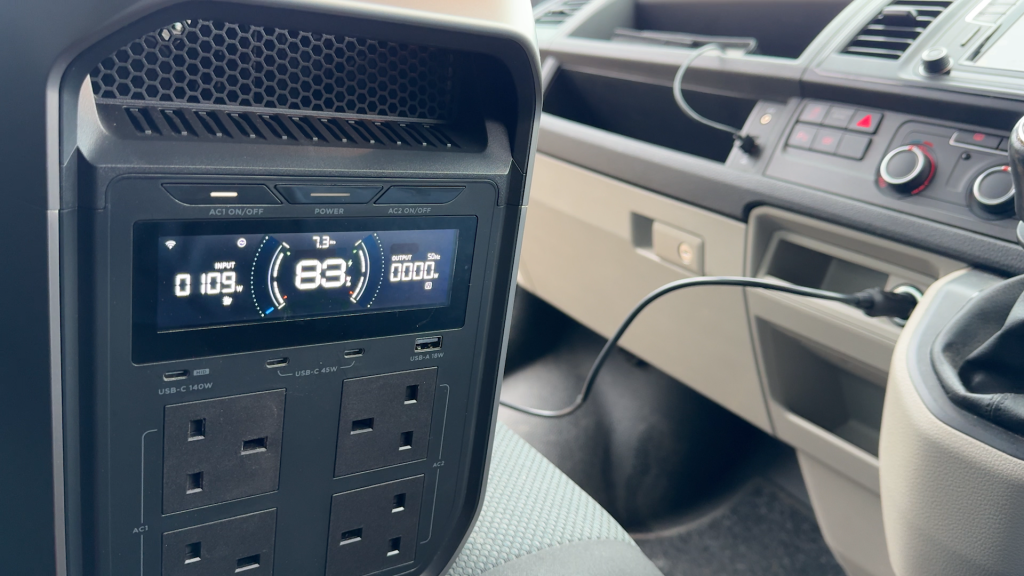
Disappointingly, EcoFlow doesn’t include a car‑charging cable, but you can buy one with an XT60 connector fairly cheaply. Plugging this into one of the DC inputs lets you charge from a car’s 12 V outlet at around 110 W.
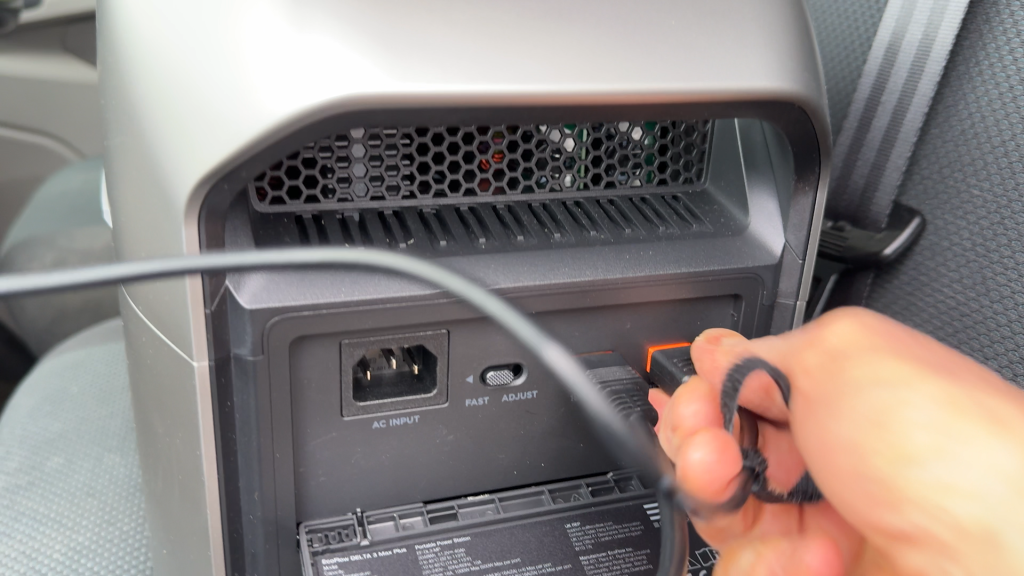
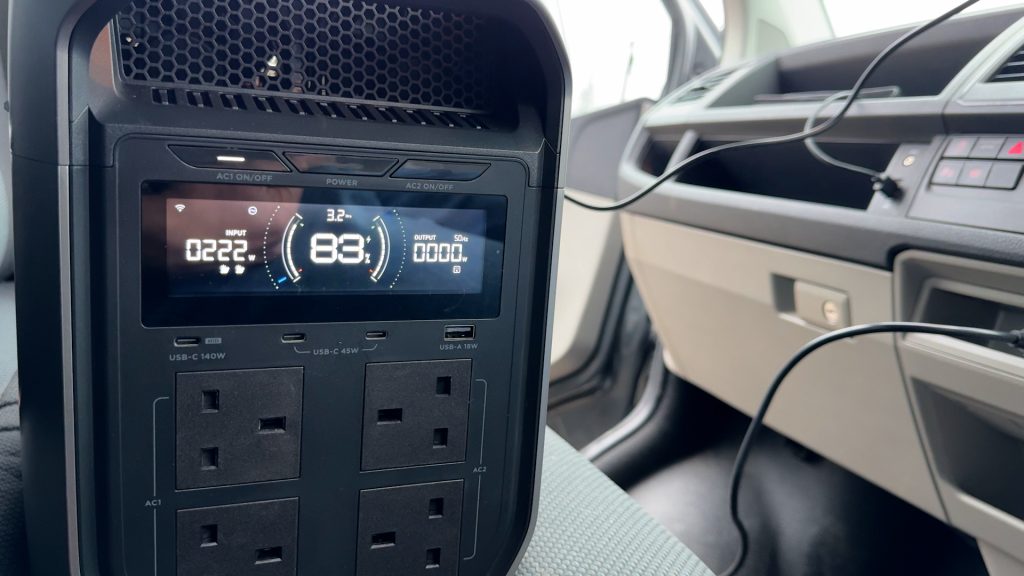
If your car has a second 12 V outlet, you can use a second cable in the other XT60 input to charge at around 220 W.
EcoFlow also sells an alternator charger that connects directly to your car battery and allows charging at up to 500 W. It can also reverse‑charge and maintain your car battery, which sounds interesting. I have one on the way and I’ll update this article once I’ve tested it.
The power station also has an integrated MPPT controller for solar charging at up to 1000 W across its two XT60 inputs. There’s no solar charging cable included, so depending on your panel connectors you’ll probably need an MC4‑to‑XT60 cable.

It’s winter here in the UK and there’s been very little sun, but I did connect a Bluetti PV350 350 W panel to one input, which worked fine, even though conditions weren’t good enough to reach triple‑digit power levels.

These two solar inputs are extremely flexible. Both support 11–60 V at up to 18 A, so you can connect two completely different panels with different voltages. Each input is limited to 500 W, meaning you need to max out both to reach the full 1000 W. I also connected a 200 W panel to the second input, which again worked fine, but there wasn’t enough sun to make much difference.

I also tested the DC inputs using my bench power supply to simulate the sun and was able to hit the full 500 W on a single input using different voltage and current combinations. One important thing to note: if you do use a standard XT60 connector, the power station assumes you’re charging from a car outlet and limits current to 8 A. To get the full 18 A, you need an XT60i connector with its ID pin shorted to ground.
This flexibility means you can use pretty much any solar panel setup, including parallel configurations and, with lower‑voltage panels, potentially even series setups – as long as you stay within the 60 V limit.
Performance

The Delta 3 Max Plus has four 3000 W pure sine wave AC outlets, that’s the maximum you can draw from a standard UK 230 V 13 A wall socket. Of the power stations I’ve tested, only the DJI Power 2000 matches this.
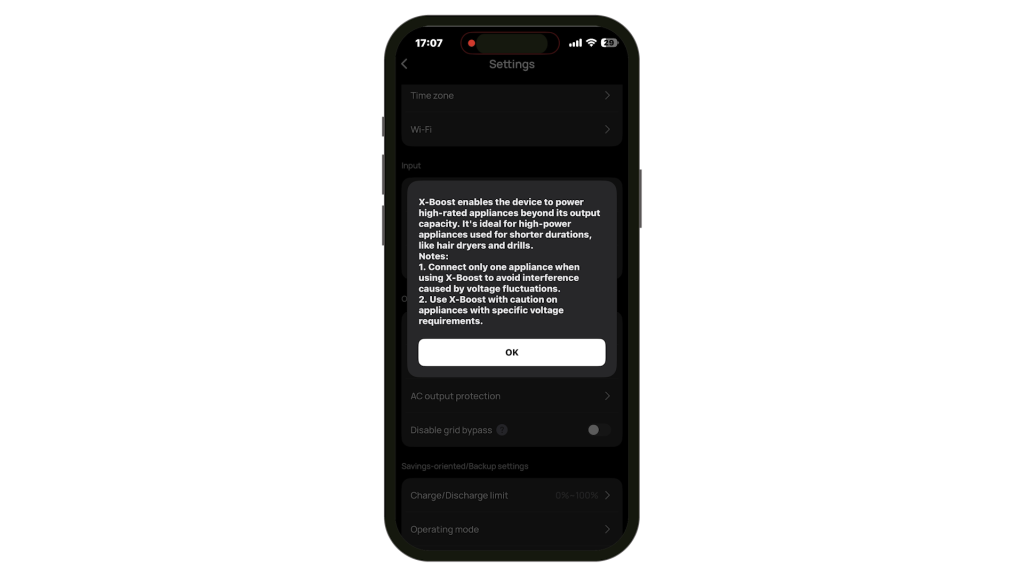
By default EcoFlow enables X‑Boost, which allows purely resistive loads like heaters or hair dryers to run at up to 3900 W by reducing the output voltage. I’d recommend turning this off unless you specifically need it, as it’s not suitable for all devices.

In real‑world use there’s very little this power station can’t run. It boils this kettle at around 2600 W, and even when I ramped a heater for a roughly 3600 W total output, it still ran for around a minute before shutting down.
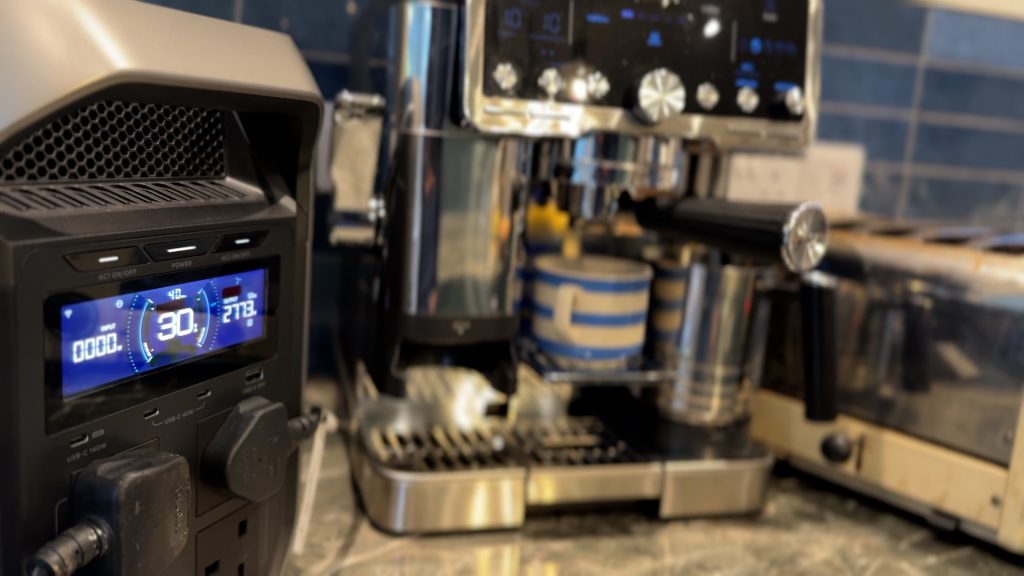
More typically, it means you can run multiple high‑power devices at the same time. For example, above I’ve got a toaster plugged in and I can still make an espresso.
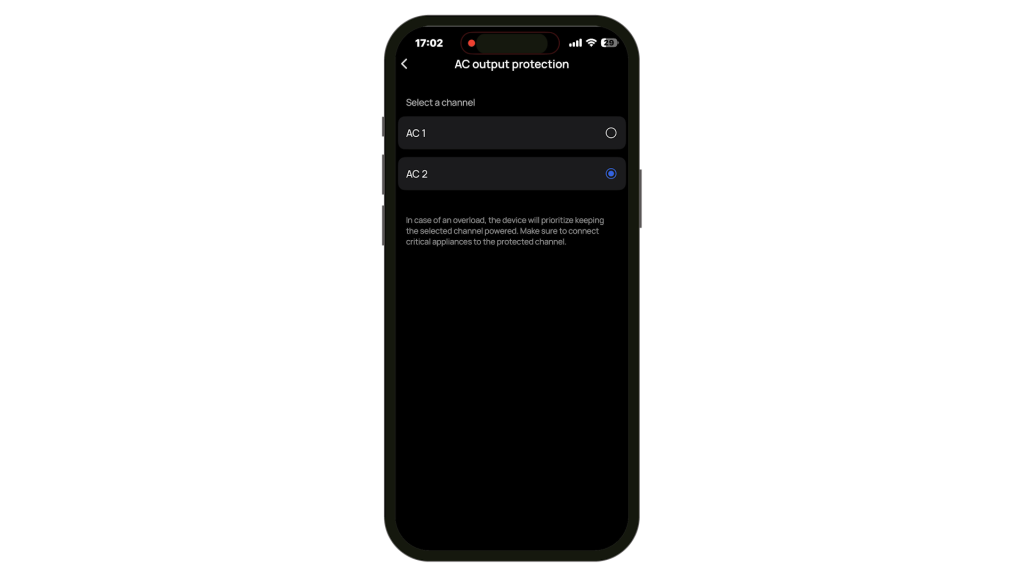
One genuinely unique feature is how EcoFlow splits the AC outlets into two independent groups: AC1 and AC2. This enables what EcoFlow calls Output Protection. By default AC2 is protected. If AC1 overloads, instead of shutting down the entire inverter, only AC1 switches off while AC2 continues to run. When AC1 is overloaded it shuts down, but the kettle plugged into AC2 keeps running. In practice, this means you can plug critical devices like a fridge or CPAP machine into the protected channel.
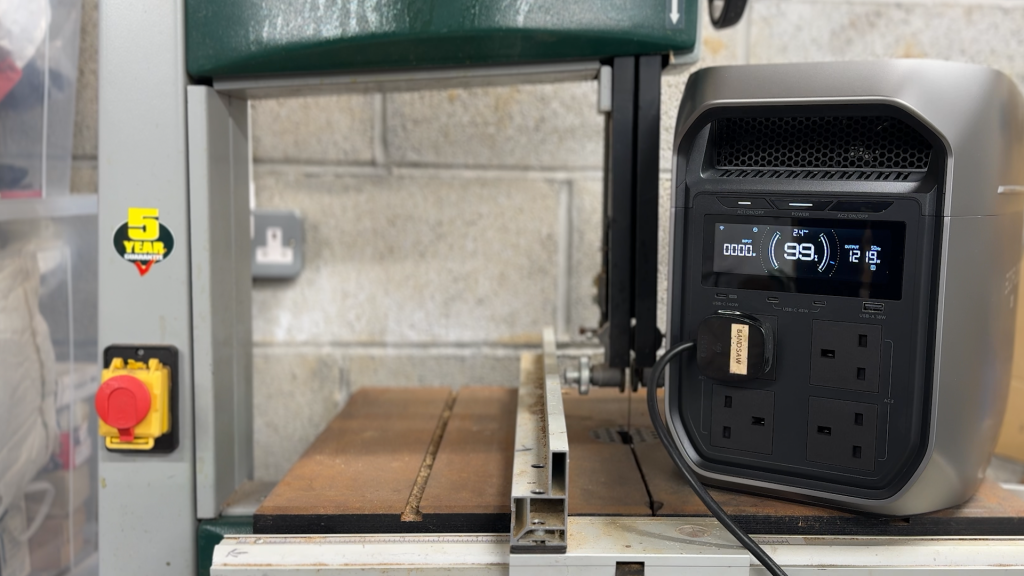
With larger power stations like this, I’m especially interested in how they handle tools, machinery and appliances with a high startup draw, typically with induction motors. My bandsaw pulls just over 26 A at startup, or a bit over 6000 W, and it started without any issue.
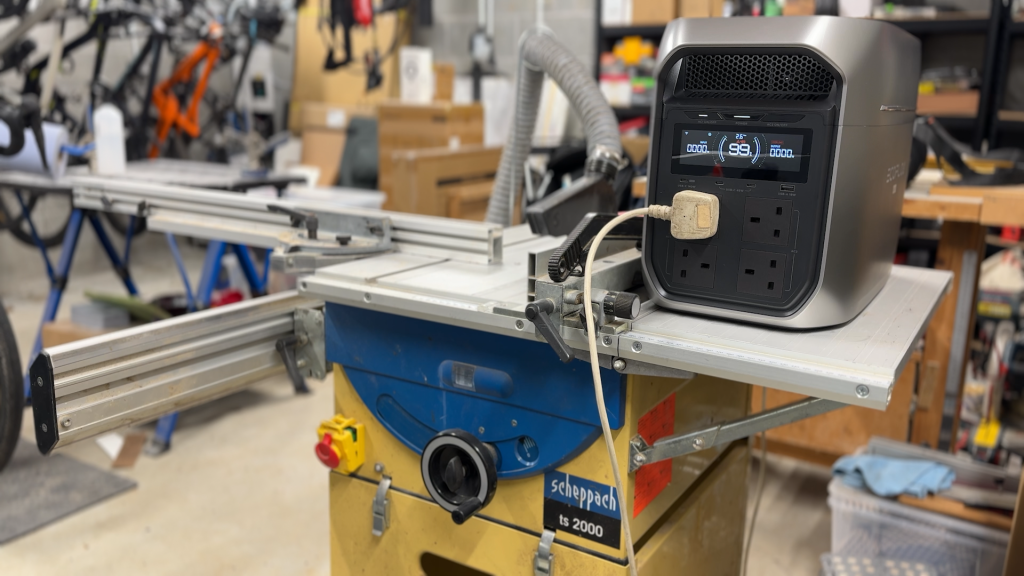
My table saw draws nearly 32 A, over 7000 W, which was too much and overloaded the unit. It also couldn’t start my planer thicknesser, which pulls around 40 A or roughly 9000 W at startup.
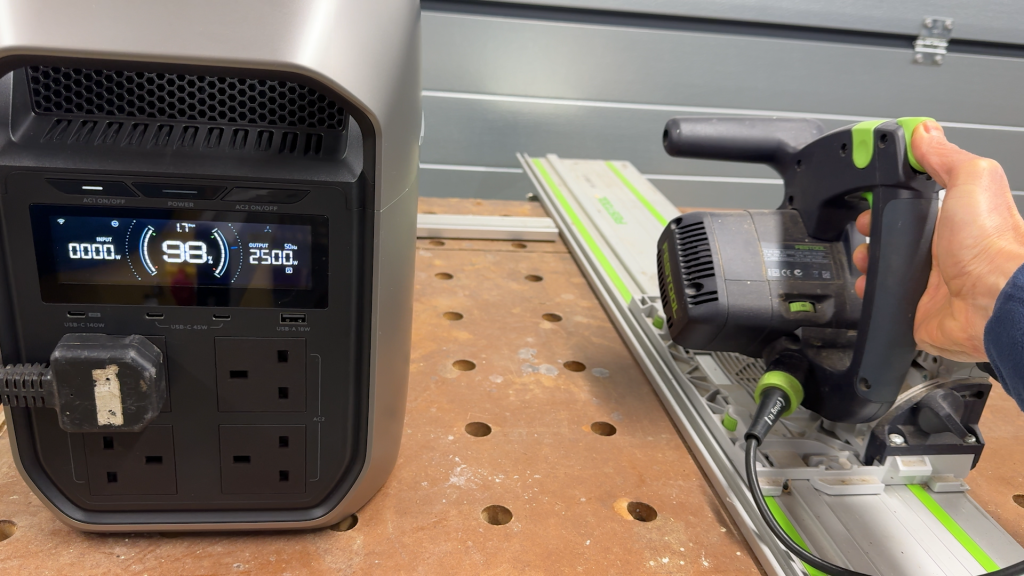
That said, it ran my large compressor, vacuum cleaner, and a bigger dust extractor without problems, as well as my 2100 W Karcher K5 pressure washer, which pulls over 6000 W when it kicks in.
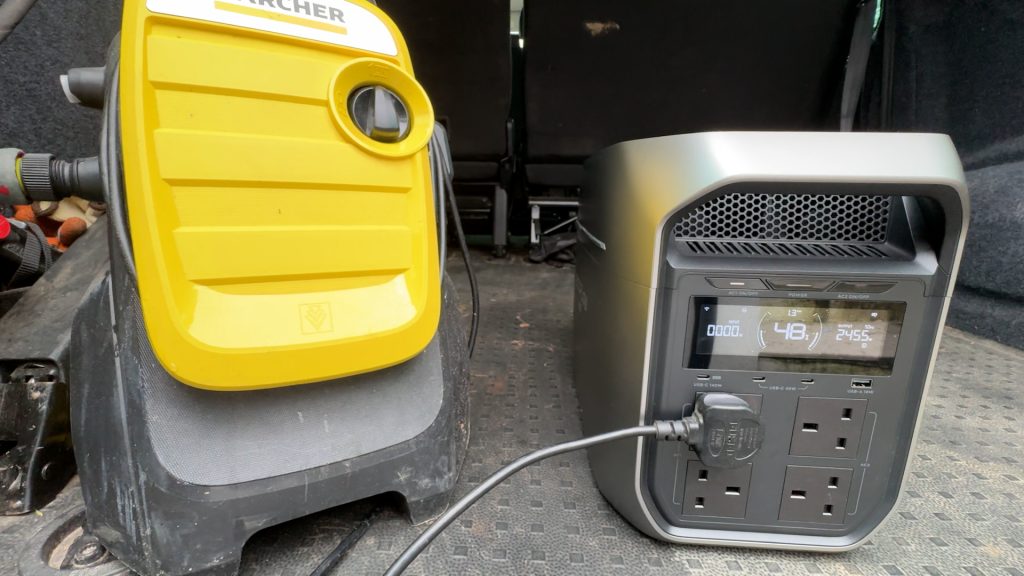
That’s genuinely useful for cleaning bikes at a trail centre before loading them back into the van.
In my office, it could also run my air‑conditioning unit, which again pulls over 6000 W when the compressor starts. Overall, performance is excellent, though I’d still like to see future generations handle even higher startup loads.
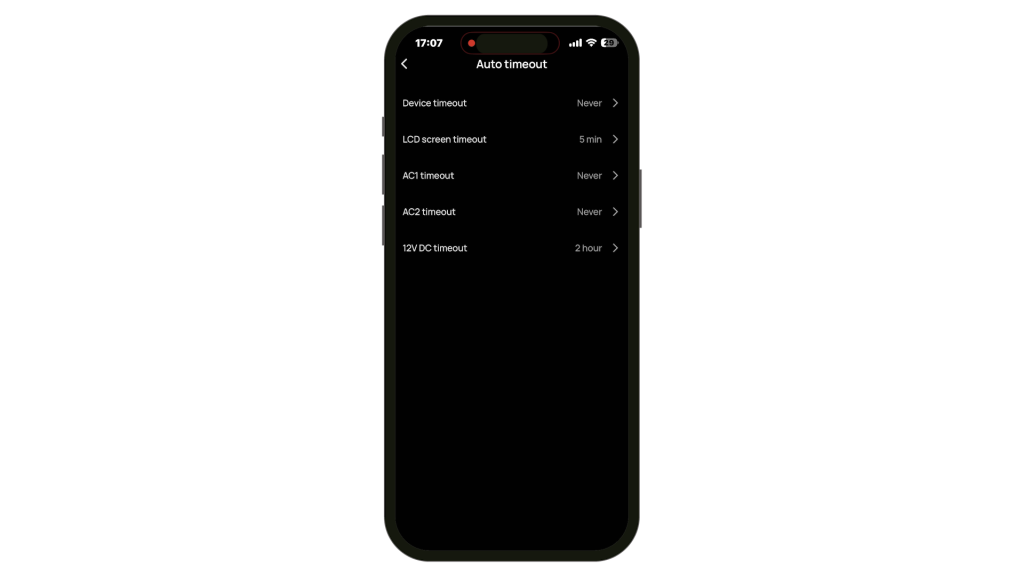
AC inverters can consume a surprising amount of power even with no load attached. By default, the EcoFlow turns off AC1 and AC2 after two hours of inactivity. I disabled this by setting both to Never in the Auto Timeout settings and left the unit overnight for 12 hours with no load connected.
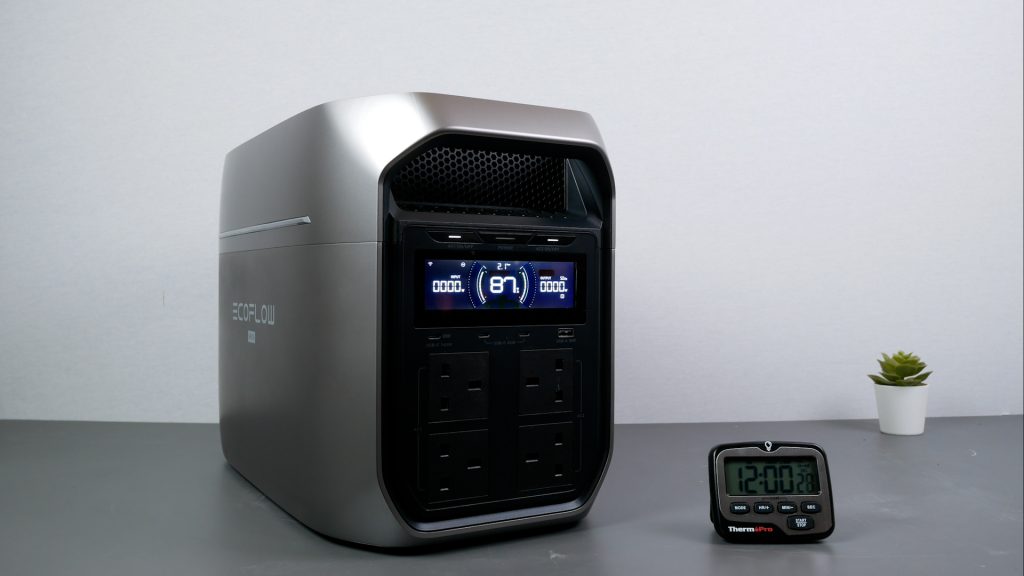
After 12 hours, the battery had dropped from 100% to 87%, meaning the inverter was drawing around 22 W with no load. That’s slightly better than the Delta 2 Max, which measured around 26 W, and very close to the DJI Power 2000, which remains the best I’ve tested at around 21 W.
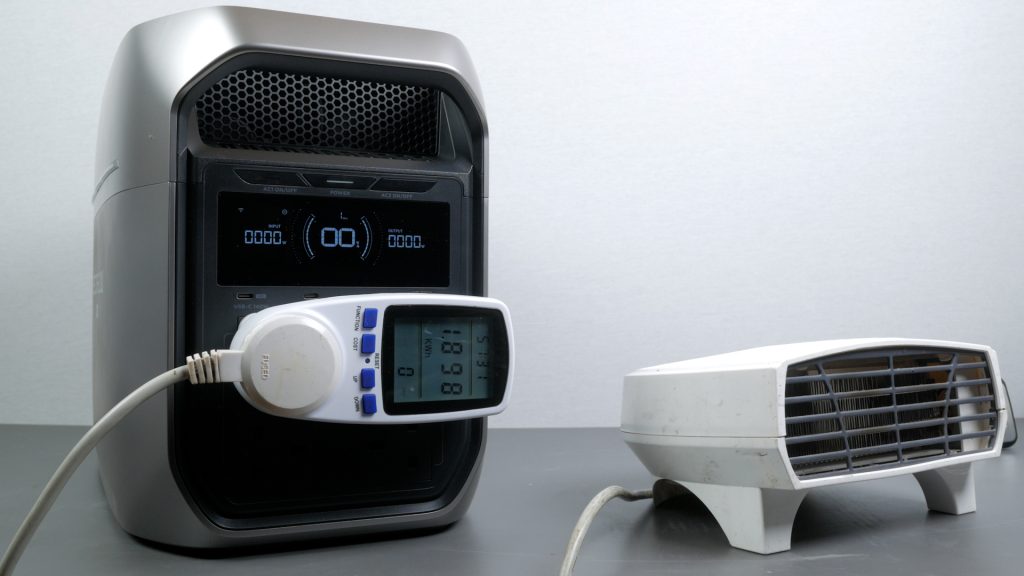
To measure usable capacity, I used an energy monitoring plug and ran a constant 2 kW resistive load using an electric heater. The power station ran for just over 57 minutes and delivered 1898 Wh from its 2048 Wh battery. That’s an impressive 93% efficiency, which is excellent for a unit of this size.
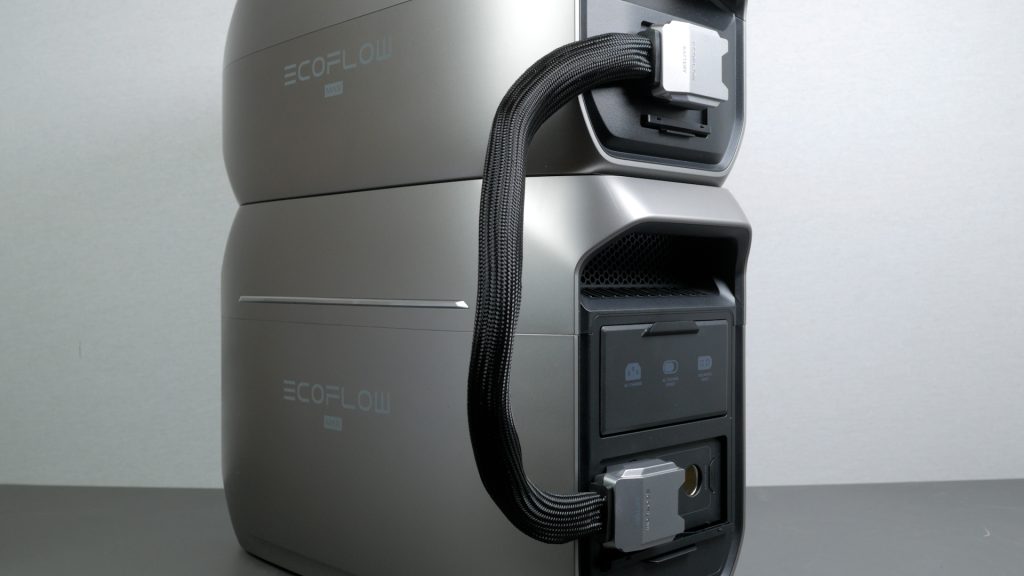
If you need more capacity, the Delta 3 Max Plus is expandable up to 10 kWh via its expansion port around the back. I’m testing EcoFlow’s 2048 Wh Smart Extra Battery, which doubles the total capacity to 4096 Wh. It connects using the included, very substantial battery cable via the proprietary 4 + 8 pin ports on both units, locking securely into place.
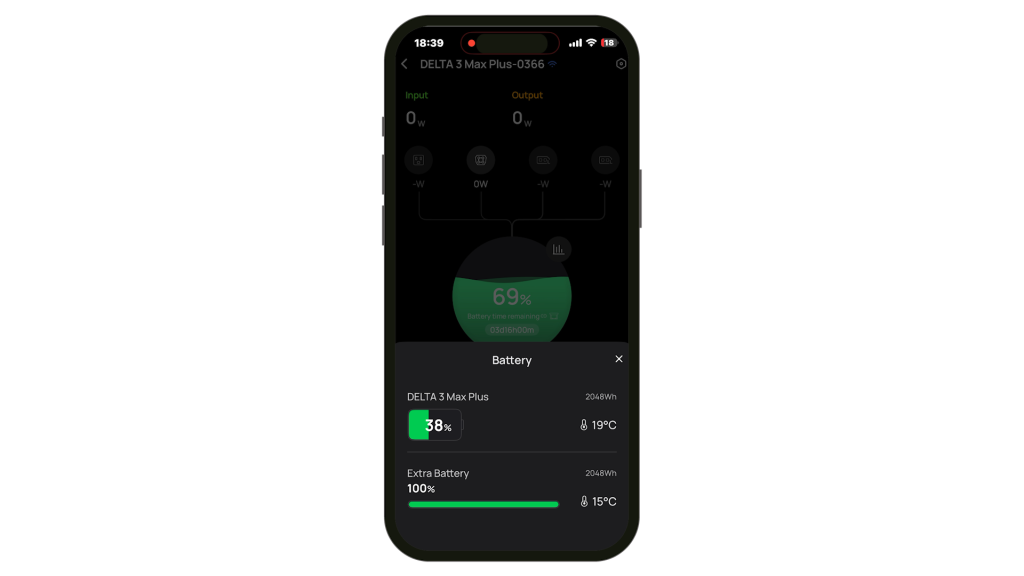
With the expansion battery attached, the app shows the combined remaining capacity, and if you tap into this you can see the individual charge levels of both the main unit and the expansion battery.

Charging performance is unaffected – it still charges at full speed. I measured just over two hours for a full charge.

I also measured usable capacity using a constant 2 kW load and got 3846 Wh, which works out at an even more impressive 94% efficiency.

A standout feature of the Delta 3 Max Plus is its 12 V 30 A DC output. EcoFlow uses an Anderson connector here, and again no adapter is included, so I had to make one up. Even with an adapter, the pins may need to be arranged vertically to fit.

I would have preferred a more common XT60 or XT90 connector, but a 30 A output is extremely useful for higher‑demand devices like fridges and diesel heaters that can spike well above the typical 10 A limit. It also allows you to run multiple DC loads at the same time, for example in a campervan.

There’s also a standard 12 V 10 A car socket for more typical accessories. I tested both DC outputs to their limits using a load tester. The 10 A output overloaded the power station at just over 10.5 A, and the 30 A output at just over 30.5 A.

I measured DC efficiency using the Anderson output with a 20 A load. The usable energy came out at 1892 Wh, which is a very strong 92% efficiency. I also measured DC idle drain with DC enabled, no load attached, and DC timeout disabled.
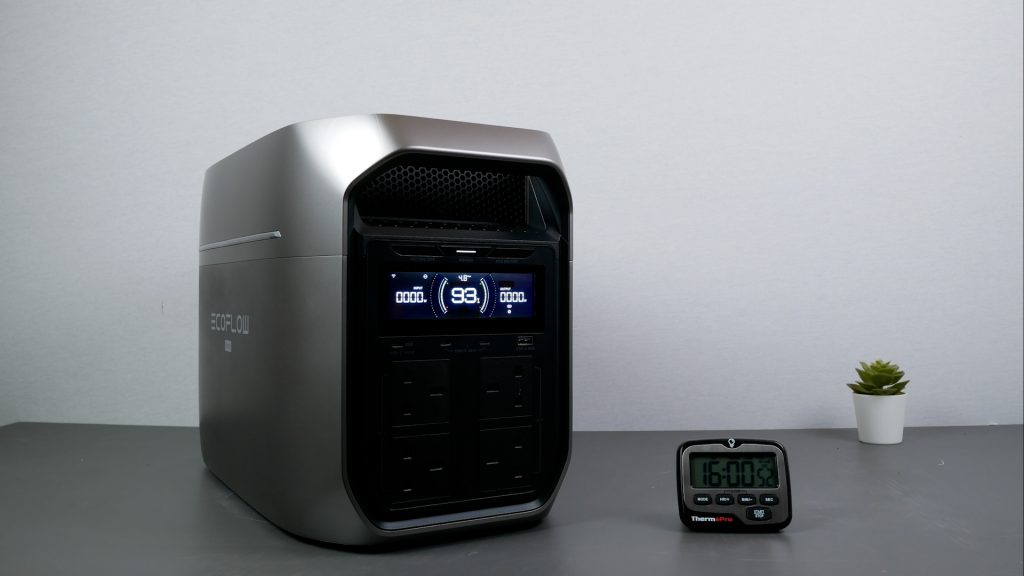
Over 16 hours the battery dropped from 100% to 93%, which works out at around 9 W of idle draw. In practical terms, that means it’s more efficient to run devices like portable fridges from the DC outputs rather than AC.
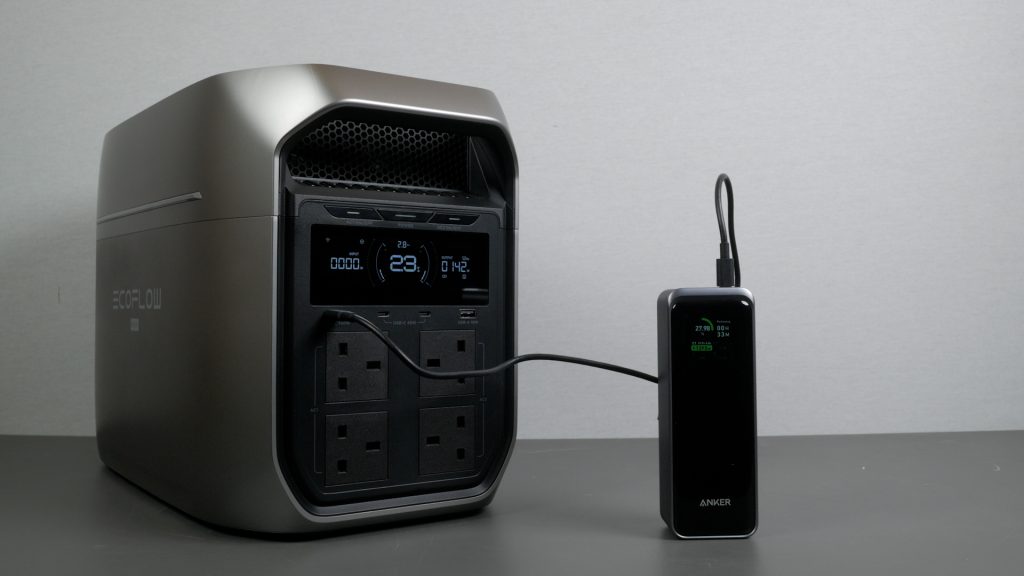
The EcoFlow offers a good selection of USB ports: one 140 W USB‑C port, two 45 W USB‑C ports, and an 18 W USB‑A port with Qualcomm Quick Charge. All of them come on automatically with the power station, which I prefer — you don’t need to enable them separately using the DC button like on some power stations. I tested the 140 W port charging an Anker power bank at full speed and used the 45 W ports to charge my MacBook, although these are a little under‑specced for laptops and other more demanding devices.
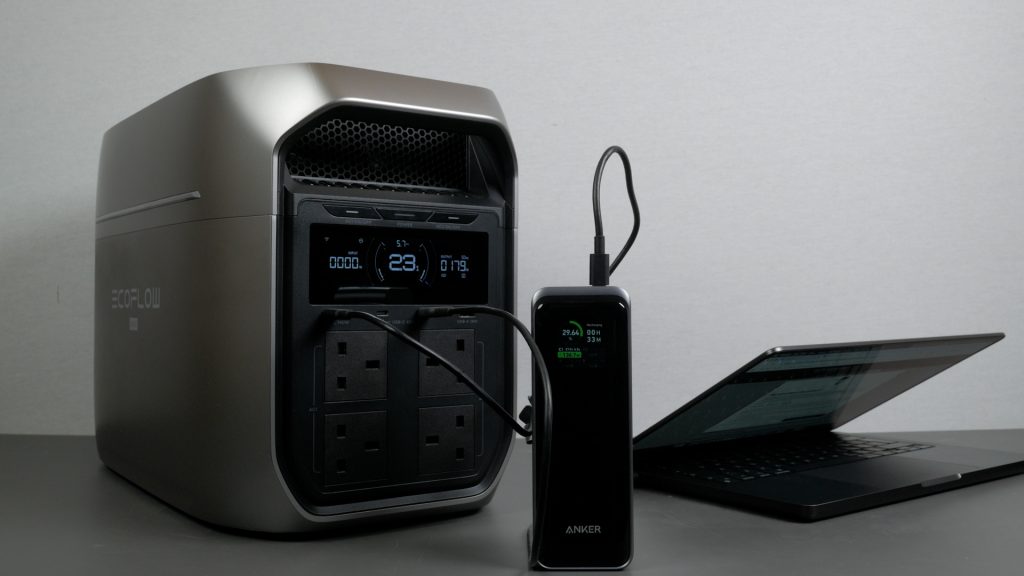
I would have liked to see at least one 100 W port alongside the 140 W port. By comparison, the DJI Power 2000 has 8 ports and includes two 140 W and two 100 W USB‑C ports.
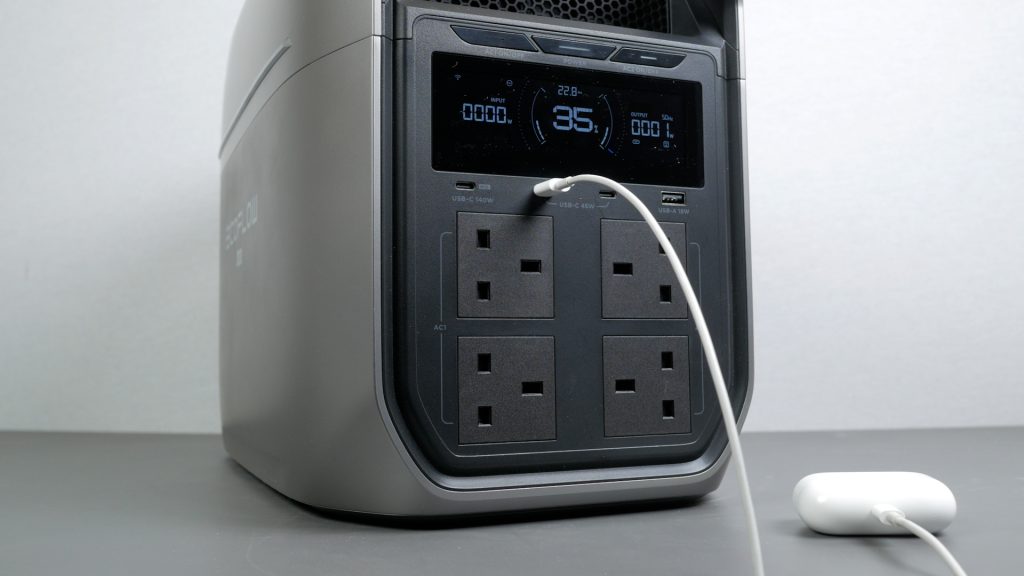
I also tested charging very low power items like my AirPods Pro which only draw around 1W. They kept charging for more than 30 minutes even with the Device timeout in the app set to 30 mins, so it doesn’t prematurely cut off very low-power devices.

I loaded all the USB ports while also running a 2 kW heater from an AC outlet with no issues. All ports support passthrough charging, so you can charge the power station and power devices at the same time.

Like most power stations, the EcoFlow includes a UPS, or uninterruptible power supply mode. When the unit is plugged into mains power, connected devices run directly off mains rather than the battery. In the event of a power cut, the switch‑over to battery happens almost instantly.
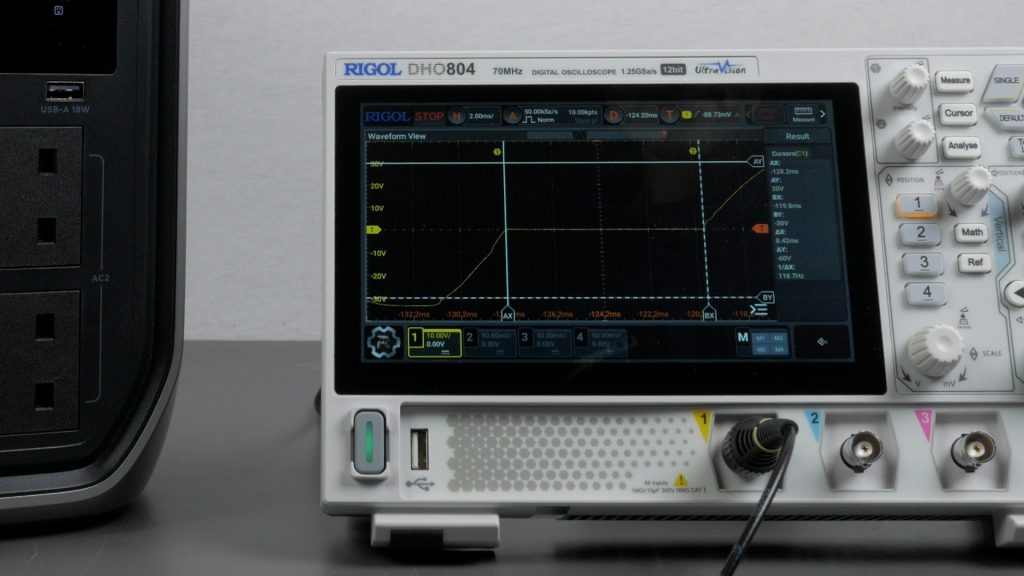
On this model, EcoFlow has improved the transfer time to under 10 ms. I tested this with my desktop PC running an intensive graphics benchmark and it handled the transition flawlessly. I also measured the transfer time using an oscilloscope and recorded a very clean handover at 8.4 ms.

It’s not officially documented for this unit, but if you install EcoFlow’s Power Manager software and connect the power station to your computer using a USB-C cable via the 140 W USB‑C port, the power station can communicate directly with your computer and trigger a clean, controlled shutdown in the event of a power cut.

This worked very reliably in my tests and adds an extra layer of protection if you’re using it as a desktop UPS. Power Manager is also available on a Mac and Synology NAS but I’ve not tested those yet.
The accompanying smartphone app is one of the most complete I’ve used on a power station. In addition to output protection, you can schedule charging and discharging, which is particularly useful if you’re on a cheap overnight energy tariff. The app also includes Output Port Memory, which remembers which outputs were enabled after the battery has been fully discharged, and restores them automatically once the unit starts charging again, typically from solar.

There’s also Storm Guard, which ensures the battery is fully charged if severe weather is forecast, and Port Priority, which lets you designate essential and non‑essential outputs so less important devices don’t drain the battery before critical ones like a fridge or freezer. Overall, it’s a genuinely useful and well‑implemented app.
Conclusions
The EcoFlow Delta 3 Max Plus is the most complete and well-rounded 2 kWh power station I’ve tested so far. You get a 3000 W inverter for AC loads, a generous 30 A 12 V output for DC, very fast and impressively quiet charging, flexible 1000 W solar input, the best UPS mode I’ve come across on a portable power station, expansion battery support, and one of the most capable smartphone apps available. And despite all that, it’s still portable – I can carry it one-handed for short distances if I need to.
There’s not much to fault. I would have liked to see at least one additional 100 W USB-C port, and I’d still love to see future generations handle even larger motor start-up surges so you don’t have to think about tripping a 3000 W inverter.

But this has to be on your shortlist if you’re after a 2 kWh power station. The DJI Power 2000 is another excellent option — it’s more compact and has better USB outputs — but it requires additional accessories for car charging, solar input, and DC outputs. So you have to weigh up what’s more important to you. Both units come with a five-year warranty. EcoFlow also has their Delta 3 Max without the Plus which is cheaper and lighter, but has a smaller inverter, no 30 A DC output and no expansion port.
I’m planning a full round-up of 2 kWh portable power stations, where I’ll go into pricing and value in more detail, so keep an eye out for that. You’ll also find up-to-date pricing and any discounts below this article, as these do change over time.
Don’t forget to take a look at my YouTube video at the top of the page, and again please subscribe to my YouTube channel where I’m releasing videos every week on the latest technology and how to get the most out of it. If you tap the bell icon when you subscribe you’ll get a notification as soon as I release a video, and there’ll be a link to my site here for the written article. YouTube is also the best place to leave a comment. I read all of them and respond to as many as I can!
If you’re wanting to purchase this power station, and you’ve found this video helpful, please consider purchasing directly from EcoFlow using my link below. It costs you nothing extra and helps support my YouTube channel and website – thank you!
EcoFlow Delta 3 Max Plus: https://tidd.ly/4q5OOAX
You can also purchase via Amazon:
Amazon link: EcoFlow Delta 3 Max Plus: https://geni.us/6eF91
As an Amazon affiliate, I get a small commission from purchases made via any Amazon links.
Leave a Reply